
Recorded December 13 & 14, 2025; published Wednesday Dec. 31, 2025
Program Notes:
(Greyed-out pieces do not appear in our playlist.)
Brightest and Best ………………..Southern Harmony (1835); arr. Shawn Kirchner (b. 1970)
Clare Bresnahan, violin solo
“Brightest and Best” features an early American tune from the Southern Harmony hymnal (1835), with a descriptive text by Reginald Heber. Shawn Kirchner employs a variety of voice combinations for each verse, and he exploits vocal range for a final climactic refrain with all voices in their highest register. Featuring solo violin and upright bass, Kirchner also utilizes piano and strings to mimic the sound of a banjo.
Hail the bless’d morn, see the great Mediator
down from the region of glory descend!
Shepherds, go worship the babe in the manger,
lo, for his guard the bright angels attend.

Brightest and best of the stars of the morning,
dawn on our darkness and lend us thine aid.
Star in the East, the horizon adorning,
guide where our infant Redeemer is laid.

Cold on his cradle the dewdrops are shining,
low lies his head with the beasts of the stall.
Angels adore him in slumber reclining,
Maker and Monarch and Savior of all.
Brightest and best of the stars of the morning,
dawn on our darkness and lend us thine aid.
Star in the East, the horizon adorning,
guide where our infant Redeemer is laid.

Shall we not yield him, in costly devotion,
odours of Edom and offerings divine,
gems of the mountain and pearls of the ocean,
myrrh from the forest or gold from the mine?

Brightest and best of the stars of the morning,
dawn on our darkness and lend us thine aid.
Star in the East, the horizon adorning,
guide where our infant Redeemer is laid.
Wexford Carol ……………………..trad. Irish, arr. Elaine Hagenberg (b. 1979)
In her arrangement of the “Wexford Carol,” Elaine Hagenberg also captures an early, rustic sound. Featuring melodic trills and a flexible meter, early Irish music is brought to life with strings, oboe, and hand drum. Similar to Kirchner, Hagenberg also employs a variety of voice combinations for each verse, and the final verse is delivered with all voices high in their range. In contrast to the exuberance and thrill of “Brightest and Best,” Hagenberg’s arrangement – especially the ending – is mystical and ethereal,
celebrating the mystery alongside the joy of the savior birth.
Good people all, this Christmas time,
Consider well and bear in mind
What our good God for us has done,
In sending His beloved Son.
With Mary holy we should pray
To God with love this Christmas Day;
In Bethlehem upon that morn
There was a blessed Messiah born.

Near Bethlehem did shepherds keep
Their flocks of lambs and feeding sheep;
To whom God’s angels did appear
Which put the shepherds in great fear.
Prepare and go, the angels said,
To Bethlehem, be not afraid;
For there you’ll find, this happy morn,
A princely babe, sweet Jesus born.

With thankful heart and joyful mind,
The shepherds went the babe to find,
And as God’s angel had foretold,
They did our Savior Christ behold.
Within a manger He was laid,
And by His side the virgin maid
Attending to the Lord of Life,
Who came on earth to end all strife.
Hodie Christus natus est ………………………Jan Pieterszoon Sweelinck (1562-1621)
Jan Pieterszoon Sweelinck was a Dutch composer, organist, and pedagogue born into a musical family in Amsterdam in the sixteenth century. His piece, “Hodie Christus natus est,” (”Christ is Born Today”) is typical of the high Renaissance and early Baroque style. The piece’s key feature is a lilting meter sung joyfully as the chorus exclaims a single word: “hodie” (“today”). This exuberant dance contrasts with the rest of the piece that features a complex web of overlapping voices. Also typical of the era, Sweelinck divides the treble voices into two equal soprano parts, and he exploits the antiphonal – or conversational – quality between these prominent voices. Imitating a brass fanfare, Sweelinck effectively captures the joy of the angel chorus proclaiming, “Glory to God in the highest.”
Hodie Christus natus est.
Hodie salvator apparuit.
Hodie in terra canunt angeli, laetantur archangeli.
Hodie exultant justi, dicentes
gloria in excelsis deo.
Alleluya.
Today Christ is born;
Today the savior has appeared;
Today the angels sing on earth, the archangels rejoice;
Today good people exult, saying,
“Glory to God in the highest.”
Alleluia!
Es ist ein Ros entsprungen ………………Michael Praetorius (1571-1621); arr. Jan Sandström (b. 1954)
“Es ist ein Ros entsprungen,” (“Lo, How a Rose e’er blooming,”) was originally composed by Michael Praetorius in the late Renaissance, and the tune remains in most Christian hymnals today. Swedish composer Jan Sandström borrows Praetorius’ hymn exactly, lifting the melody and harmony. A small group sings the original piece in German, while Sandström weaves a newly composed web of voices around the undisturbed hymn. The effect is marvelous: surely inspired by the opening line, “Lo, how a Rose e’er Blooming,” Sandström creates an aural depiction of the flower slowly opening its petals. With a painfully slow tempo and long sustained lines, the aural creation is stunning and it remains one of the most inventive adaptations of a Renaissance piece by a modern composer.
Es ist ein Ros entsprungen
aus einer Wurzel zart,
als uns die Alten sungen,
von Jesse kam die Art
und hat ein Blümlein bracht
mitten im kalten Winter
wohl zu der halben Nacht.
Lo, how a Rose e’er blooming
From tender stem hath sprung!
Of Jesse’s lineage coming
As men of old have sung.
It came, a flower bright,
Amid the cold of winter
When half-gone was the night.
Spaséñiye, sodélal ……………… Pavel Chesnokov (1877-1944)
Pavel Chesnokov was a Russian composer, choral conductor, and teacher best known for his hundreds of sacred choral compositions. “Spaséñiye, sodélal” (“Salvation is Created”) was composed in 1912 as the fifth piece in his Ten Communion Hymns, and it is his most famous and widely performed work today. Sung in Church Slavonic, this piece is emblematic of many Eastern works in the twentieth century: the melody
is sung in octaves in the tenors and sopranos, and the low voices divide and descend to exceptionally low registers.
Spaséñiye sodélal yesí posredé ziemlí, Bózhe.
Allilúiya.
Salvation is wrought in the midst of the earth, O God.
Alleluia.
Happy Holidays / White Christmas ………………Irving Berlin (1888-1989); arr. Ed Lojeski
Imran Goychayev, assistant conductor
“Happy Holiday” and “White Christmas” were both composed by Irving Berlin for the 1942 movie Holiday Inn, featuring Marjorie Reynolds and Bing Crosby. Famously, Crosby’s first public performance of “White Christmas” was a few weeks after the attack on Pearl Harbor. As a Jewish immigrant, it is noteworthy that Irving Berlin’s hits changed the American Christmas market forever as they launched decades of songs
focused on family, home, and nostalgia.
Happy holiday, happy holiday,
While the merry bells keep ringing
May your every wish come true.
Happy holiday, happy holiday,
May the calendar keep bringing
Happy holidays to you.
I’m dreaming of a white Christmas
Just like the ones I used to know,
Where the treetops glisten and children listen
To hear sleigh bells in the snow.
I’m dreaming of a white Christmas
With every Christmas card I write,
“May your days be merry and bright
And may all your Christmases be white.”
Deck the Halls………………………..arr. Pentatonix; adapted by Mac Huff
“Deck the Halls” is a traditional Welsh carol dating back to the sixteenth century. Mac Huff adapted this arrangement based on a performance by Pentatonix, a modern a cappella group from Arlington, Texas. Pentatonix gained notoriety after winning the third season of NBC’s “The Sing-Off,” and they are one of the best known American vocal groups today. This lively arrangement is notable for its original refrain that
modulates up a half step each time.
Deck the hall with boughs of holly,
Fa la la la la, la la la la.
’Tis the season to be jolly,
Fa la la la la, la la la la.
Don we now our gay apparel,
Fa la la, la la la, la la la.
Troll the ancient Yule-tide carol,
Fa la la la la, la la la la.
See the blazing Yule before us,  (Fa la la...)
Strike the harp and join the chorus,  (Fa la la...)
Follow me in merry measure,  (Fa la la...)
While I tell of Yuletide treasure,  (Fa la la...)
Fast away the old year passes, (Fa la la...)
Hail the new, ye lads and lasses, (Fa la la...)
Sing we joyous all together, (Fa la la...)
Heedless of the wind and weather,  (Fa la la...)
See Amid the Winter’s Snow……………….John Goss (1800-1880); arr. Dan Forrest (b. 1978)
“See Amid the Winter’s Snow” is a nineteenth-century English Christmas carol with a text by Edward Caswall and a tune by Sir John Goss. Dan Forrest’s arrangement is notable for the various settings of the world “alleluia,” which means “praise be to God,” as he effectively creates a very dynamic and dramatic piece. The opening is rather wondrous and utilizes high muted strings as the choir sings “alleluia” to a slow, simple, and sustained line. In the middle of the piece, the choir exclaims “alleluia” in octaves with an expansive and grand melodic contour. To conclude, Forrest captures a reverent tone as all voices descend in range and sing “Alleluia” one final time.
Alleluia!
See, amid the winter’s snow,
born for us on earth below,
see the tender Lamb appears,
promised from eternal years.

Hail, thou ever blessed morn!
Hail, redemption’s happy dawn!
Sing through all Jerusalem,
“Christ is born in Bethlehem.”
Alleluia!
Lo, within a manger lies
He who built the starry skies;
He who, throned in height sublime,
sits amid the cherubim!
(Hail...)

Sacred Infant, all divine,
what a tender love was Thine,
thus to come from highest bliss
down to such a world as this!
(Hail...)
Silent Night ….……………….Franz Gruber (1787-1863); arr. Shawn Kirchner (b. 1970)
“Silent Night” represents a collaboration between a Catholic priest, Joseph Mohr, and organist Franz Xaver Gruber. The piece was first performed on Christmas Eve in 1818 in Oberndorf, Austria. Mohr’s church organ was damaged in a flood, so he asked Gruber to compose an original melody with guitar accompaniment. Aiming to compose an easy song that could be accompanied by guitar, the simplistic beauty of Gruber’s tune is a product of the misfortunate flood and inoperable organ. With only moderate adornment, arranger Shawn Kirchner masterfully allows the beautiful tune to shine.
Silent night, holy night,
All is calm, all is bright.
Round yon virgin
mother and child!
Holy Infant so tender and mild,
Sleep in heavenly peace,
Sleep in heavenly peace.
Silent night, holy night,
Son of God, love’s pure light.
Radiant beams from Thy holy face,
With the dawn of redeeming grace,
Jesus, Lord, at Thy birth,
Jesus, Lord, at Thy birth.
Silent night, holy night,
Wondrous star, lend the light;
With the angels let us sing
Alleluia to our King;
Christ the Savior is born,
Christ the Savior is born.
O Come, All Ye Faithful ….……………….John Francis Wade (1711-1786); arr. Dan Forrest (b. 1978)
featuring Kristen Wright and Cori Belle, piano
Dan Forrest crafted a unique accompaniment for John Francis Wade’s eighteenth-century “O Come, All Ye Faithful.” Featuring snappy rhythms and a festive march, the four-hand piano accompaniment brings new life to this old hymn. After a brief break in the texture in the third verse, the voices quickly enter one after the other creating a large crescendo and a climactic ending.
O come, all ye faithful, joyful and triumphant,
O come ye, O come ye to Bethlehem!
Come, and behold Him, born the King of angels!
O come, let us adore Him;
O come, let us adore Him;
O come, let us adore Him, Christ, the Lord!
Sing, choirs of angels; sing in exultation;
sing, all ye citizens of heaven above!
Glory to God, all glory in the highest!
(O come...)

Yea, Lord, we greet Thee, born this happy morning;
Jesus, to Thee be all glory given!
Word of the Father, now in flesh appearing!
(O come...)
Illuminare ………………………….Elaine Hagenberg (b. 1979)
Set for choir and chamber orchestra, Elaine Hagenberg’s “Illuminare“ is truly unique in modern choral repertoire. Hagenberg selected five lesser-known Latin texts and masterfully created a larger work with a dramatic arc. The first two movements present themes of light and love, respectively. The opening movement’s melodic figure is set to the text “Splendor” and is full of large, ascending leaps as the fanfare heralds the appearance of light. The second movement features the treble singers, and Hagenberg crafts a beautifully warm melody, a lush texture, and an inviting harmonic palette. In stark contrast, the third movement ushers in darkness and evil, as illustrated by the frantic tempo, combative percussion, mixed meter, and extreme low and high ranges of the singers and instruments. The fourth movement is unique
in two notable ways: Whereas the texts of all the other movements present a third-person descriptive narrative, the fourth movement is a first-person prayer for peace. Additionally, while the entire work is in Latin, Hagenberg presents the only English text in the entire work at this turning point in the larger narrative: Responding to the prayer request, Hagenberg selects verses from John’s Gospel, “peace I give to you. . . let not your heart be troubled, neither let it be afraid.” In the beginning of the final movement, the orchestral texture slowly builds as the light of the first movement returns. The chorus sings “Illuminare” set to a new melodic motive, but similar to the first movement, the voices are marked by large leaps and a declamatory style.
Violin: Clare Bresnahan, Eric Rynes, Angi Kam, Andrew Kam;
Viola: Mariya Ksondzyk; Cello: Mary Riles, Daniel Mullikin;
Bass: Ramon Salumbides;
Flute: Merrie Siegel Parmley; Oboe: Janet Putnam;
Horn: Amie Stewart, Burke Anderson;
Percussion: Bob Rees, Frank Ronneberg;
Piano: Cori Belle
I. Splendor
Splendor paternae gloriae,
de luce lucem proferens,
lux lucis et fons luminis,
diem dies illuminans.
Splendor of God’s glory,
brings forth light from light,
light of light, light’s living spring,
Day, all days illuminates.
II. Caritas
Caritas abundat in omnia,
de imis excellentissima
super sidera,
atque amantissima in omnia,
Quia summo regi
osculum pacis dedit.
Love abounds in all,
from the depths most excellent
to beyond the stars,
and loving toward all,
she has given the highest king
the kiss of peace.
III. Nox
Kyrie eleison. Christe eleison.
Nox et tenebrae et nubila,
confusa mundi et turbida
Caligo terrae scinditur
percussa solis spiculo.
Lord have mercy. Christ have mercy.
Night and darkness and fog,
confused world and turmoil
dark gloom tears the earth
beats and stabs the sun.
IV. Munera Pacis
Ecce jam noctis tenuatur umbra,
Lux et aurorae rutilans coruscat:
Supplices rerum Dominum canora
Voce precemur:

Ut reos culpae miseratus, omnem
Pellat angorem, tribuat salutem,
Donet et nobis bona sempiternae
Munera pacis.
Behold, already night and shadows taper off
Light and dawn sparkle and quiver
We humbly beg the Lord through song
Our voices pray:

Though we are guilty, view us with compassion
Banish anguish, bestow health
Grant us everlasting goodness
Give us peace.
Peace I leave with you, my peace I give unto you:
not as the world giveth, give I unto you.
Let not your heart be troubled, neither let it be afraid.
V. Illuminare his
Illuminare his qui in tenebris
et in umbra mortis sedent:
ad dirigendos pedes nostros in viam pacis.
Illuminate those in darkness
and in the shadow of death are seated
direct our footpath in the way of peace.
~~Program notes by Ben Luedcke
Personnel:
Bellevue Chamber Chorus
https://bellevuechamberchorus.org/about/
Ben Luedcke, Artistic Director
Cori Belle, Accompanist
Imran Goychayev, Assistant Conductor
December 2025 Chorus Personnel:
Soprano: Maria Bayer, Debra Defotis, Megumi Hayashi, Emily Lapin, Melissa Malouf,
Kathy McMillan, Meg Oshima, Audrey Wang Gosselin*, Jane Wasell
Alto: Toma Aliyeva*, Kristine Bryan*, Kristine Gilreath, Christine Goetzinger,
Monica Harris, Anita Lenges, Michelle Lin, Marcia Olmsted, Kristen Wright*
Tenor: Imran Goychayev, Melanie Grube, Michael Grube, Jim Leininger*, Kennedy Stewart,
Alexander Stolpovsky, Albert Tsai, David Varner, Jamie Walch
Bass: Orion Bloomfield, Allan Chartrand, Dennis Defotis, Jan De Wulf, Mark Liebendorfer,
Gabriel Malouf, James McTernan*, Fabien Mousseau, Eric Mullen, John Schleg,
Yan Smolyak, Trevor Tsang, Lawrence Yang
* board member
Guest Artists:
Clare Bresnahan, concertmaster and violinist
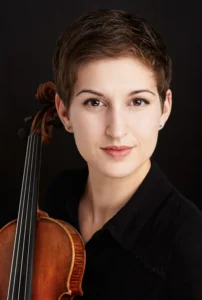
Clare Bresnahan is a violinist, educator, nonprofit administrator, and gardener in the Pacific Northwest. She has extensive experience performing with orchestras and chamber music ensembles across the country, and has a particular interest in projects that address historical inequities in the classical music industry. She is also a recording artist for movie, television, and video game soundtracks and has performed with artists such as The Who, Weird Al, and Andrea Bocelli. Clare holds a Master of Music degree from University of Wisconsin-Madison, where she studied with violinist David Perry and the Pro Arte String Quartet.
In addition to her performing career, Clare teaches violin and viola lessons, runs a gardening business with her partner, and serves on the board for Seattle Arts and Culture for Anti-Racism. She enjoys backpacking, connecting with new people and dear friends, and learning new things ranging from the particulars of beer styles to the science of wildfires.